Homeowners insurance commonly covers water damage that is sudden and accidental — a pipe that bursts, a supply hose that fails, a water heater that lets go. It generally does not cover damage from gradual leaks, long-term seepage, or deferred maintenance, and it does not cover flooding from rising external water, which requires a separate flood policy.
The distinction that decides most water damage claims
Sudden and accidental, or developed over time
Nearly every coverage question about water comes down to one question the carrier asks: was this sudden and accidental, or did it develop over time? A supply line that splits and empties across a ground floor overnight is the classic sudden-and-accidental loss. A drain connection that has been weeping behind a vanity for months, quietly rotting the cabinet base, is the classic denial. The volume of water isn't what separates them. Time is.
Why insurers draw the line there
That's frustrating when the slow leak was genuinely invisible. But the logic is consistent: property insurance is designed for sudden events, not for deterioration, which insurers treat as maintenance. Coverage varies by policy, so the wording of yours is what actually governs your claim.
What "sudden and accidental" usually looks like
Common covered failures
Many standard policies respond to water that escapes abruptly from plumbing, heating, cooling, or household appliances. In practice, that often includes a burst or split supply line, including the braided hoses behind toilets, sinks, and washing machines; a water heater tank that fails; a dishwasher, refrigerator ice maker, or washing machine that discharges unexpectedly; rain entering through an opening that a covered peril created, such as wind removing roofing material; and pipe damage caused by freezing, though many policies condition this on the home being heated or the system drained.
The resulting damage versus the failed part
There's a wrinkle worth knowing: policies frequently cover the resulting damage — the soaked flooring, drywall, and contents — while excluding the failed part itself. The ruined floor may be covered while the pipe that failed is yours to repair. Many policies also address the tear-out needed to reach failed plumbing, but that treatment differs from carrier to carrier.
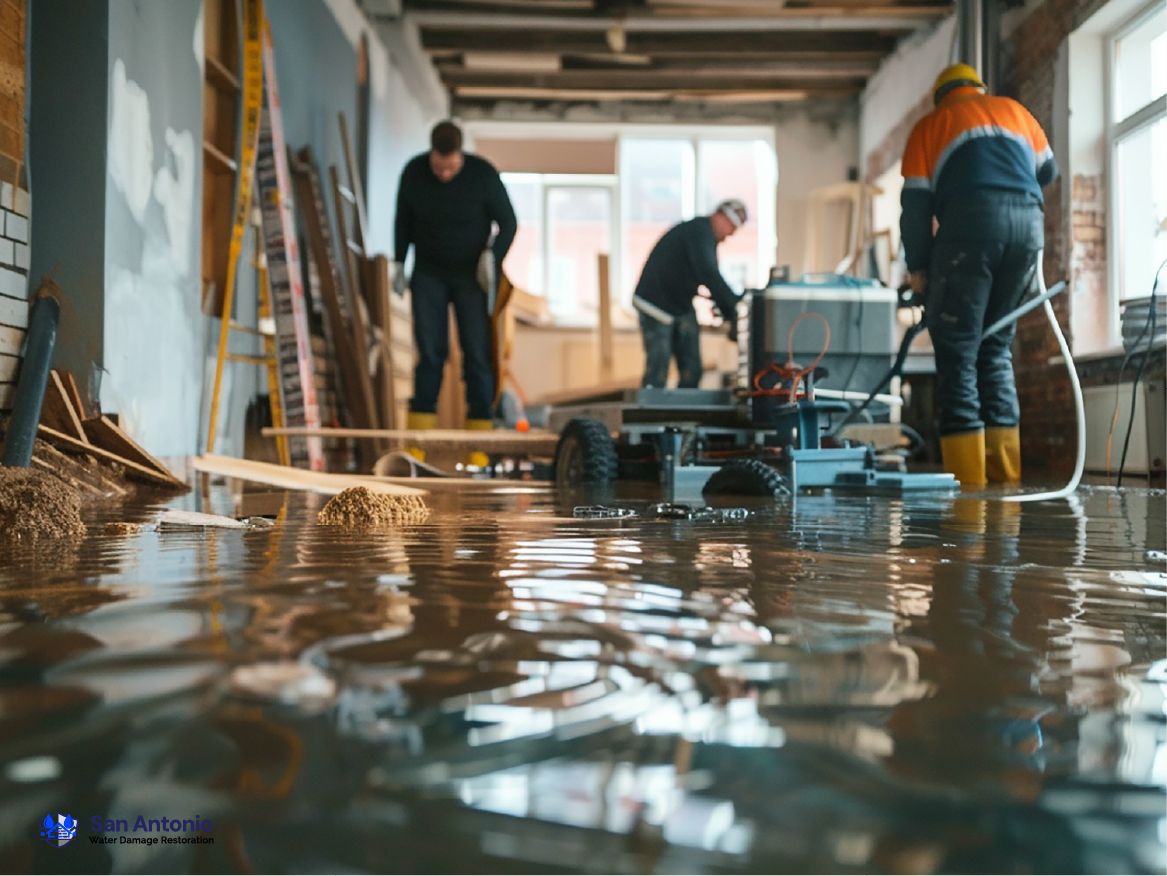
Water damage restoration work — San Antonio, TX
Why gradual leaks are usually excluded
What a slow-leak denial typically involves
Standard policies typically exclude damage from continuous or repeated seepage over an extended period, along with wear and tear, rot, corrosion, and general lack of maintenance. Slow-leak denials tend to involve a drain or supply connection that has dripped inside a wall or cabinet for weeks or months; under-slab plumbing that has been leaking gradually, which in this region is often the result of expansive clay soils shifting and stressing older cast-iron or galvanized lines; grout and caulk failures in a shower that let water into the subfloor over time; a roof that has been leaking through worn material rather than through storm damage; and condensation issues around HVAC equipment and drain pans.
How adjusters read duration
If the adjuster's inspection finds staining layers, established rot, or existing mold, those are read as evidence of duration. This is the strongest practical argument for calling in extraction fast: if the loss genuinely was sudden, a dated record from day one is what proves it before the evidence degrades.
Flooding is a different category entirely
What "flood" means to an insurer
This surprises a lot of homeowners: standard homeowners policies generally exclude flood. Flood in the insurance sense means water arriving from outside and rising — overflowing creeks and rivers, storm surge, and surface water running across the ground and into the structure. That gap matters more in Flash Flood Alley than almost anywhere, since a home here can take on water from outside without a single plumbing failure in it — the local runoff and soil conditions behind that are set out on our San Antonio water damage page.
Flood coverage, backup, and mold sit apart
Flood coverage is purchased separately, through the National Flood Insurance Program or a private carrier, and typically carries its own waiting period before it takes effect. Being outside a mapped high-risk zone doesn't mean water can't reach you — it means your lender didn't require the policy, and that the premium outside a high-risk zone is usually much lower. Two related situations often sit in their own category as well. Sewer and drain backup: water coming up through floor drains, tubs, or toilets is frequently excluded unless a specific water backup endorsement was added. Mold: mold coverage is often limited or excluded outright, and where it exists, it's frequently capped or tied to whether the underlying water event was covered.
Your duties after a loss — this part is on you
Notice, mitigation, documentation, and cooperation
Most policies impose obligations on the policyholder after damage occurs, and failing to meet them can jeopardize an otherwise covered claim. Broadly, they include the following. Prompt notice. Report the loss without unnecessary delay, even before you know the full scope. Reasonable mitigation. You're expected to take sensible steps to prevent further damage — shutting off water, extracting, drying, covering an opening. Letting a wet home sit while you wait for an adjuster can create damage the carrier attributes to you rather than to the original event. Documentation. Photos and video before cleanup, a written inventory of damaged property, and every receipt connected to the loss, including emergency work and temporary living costs. Access and cooperation. Allowing inspection of the property and the damaged materials, and answering questions about the cause and timeline.
Photograph first, then act
Mitigation and documentation aren't a contradiction. Photograph first, then act — and keep photographing as the work proceeds. Our guide to what to do in the first 24 hours after water damage covers that sequence in detail. A restoration crew's moisture readings, equipment logs, and daily notes are exactly the kind of third-party record adjusters can work from, which is one reason bringing in a water damage repair company early tends to help a claim rather than complicate it.
Read your own policy — and ask these questions
Questions worth putting to your agent or adjuster
Coverage differs meaningfully between carriers, policy forms, and endorsements. Before you assume anything about your situation, look at your declarations page and ask your agent or adjuster directly: Does my policy cover sudden discharge from plumbing and appliances, and does it cover the tear-out needed to reach the failure? Do I have a water backup endorsement for sewer or drain overflow? Do I have flood coverage, and if so, through whom? How does my policy handle mold that follows a covered water loss? Is my personal property settled at replacement cost or actual cash value? What are my duties after a loss, and what does the policy require me to document? Ask for the reasoning in writing if a claim is denied. Denials are sometimes based on an assumption about duration that better documentation can address.
General information, not insurance advice
This article is general information about how water damage claims commonly work, not insurance advice. Your policy language, endorsements, and carrier decide your coverage — read your policy and talk to your agent or adjuster about your specific situation. If water is spreading through your home while you're still sorting out the coverage question, handle the water first. Call (726) 237-3201 and get extraction and drying underway — that's the step that protects both the structure and the claim.
Dealing With Water Damage Right Now?
Lines are answered 24/7 and crews are dispatched across San Antonio at any hour. Call now, or request a callback.
📞 Call (726) 237-3201